The AELA conferences are always a joy to attend, particularly since they have been hosted at the Griffith University Eco-centre on the beautiful Nathan campus. There is a great mix of academics (both Australian and international), as well as community groups, and, increasingly, First Nations and Indigenous peoples.
Understanding and improving the legal status of nature requires a deeper understanding of First Nations law and ethics, which emphasise an ongoing relationship with land and water. It was a particular privilege to hear Professor Graham's discourse on the changing ethic of our collective relationship to country, as we move from a survivalist ethos (which often places us into conflict and competition with each other, and nature) into a relational ethos that emphasises our relationship with nature, and our obligations to nature.
I presented my research findings on the unexpected challenge that can arise when nature's rights are recognised in a Western legal framework (with its emphasis on individuality), and the paradox which can result: increasing nature's legal rights can weaken the willingness of communities to protect nature.
The paradox of legal rights: as legal protection goes up, this can lead to increasing complacency and an abdication of our responsibilities to look after the environment
Understanding this paradox requires going back to basics, and considering how the environment has been constructed in law over time. My new book explores this in detail, concluding that although there are myriad and widely different definitions of the environment in law, there are three main constructions of the environment in law: (1) a socio-ecological concept, (2) a legal object, and, most recently, (3) a legal subject.
Understanding the paradox of legal rights for nature requires an understanding of how the environment is constructed in law
By focusing on the way the environment is constructed in law, we can also start to identify the underlying cultural narratives, and the way those narratives can shape our legal response (and even drive legal reform). The legal object has no rights of its own, and links the concepts of legal weakness with the idea of being 'worthy' of protection. Alternatively, the legal subject does have legal rights, and transforms this narrative into one where the environment can, and thus should, look after itself. These tensions have specific consequences for the environment, because of the initial construction as a highly flexible socio-ecological concept - it can be whatever it is defined to be, but it is only ever what we articulate it to be. As a result, the overarching concept of what the environment is, and why it matters, is highly vulnerable to shifting social values. Changing cultural narratives can lead to large shifts in law.
Tensions between the different constructions of the environment in law can lead to significant shifts in the broader socio-ecological concept
This paradox is not, of course, a foregone conclusion of granting legal rights to nature. The rivers that have received legal rights over the past couple of years have taught us some important lessons.
We can mitigate this paradox by:
(1) centering First Nations values and perspectives, as happened for the Whanganui River;
(2) connecting people and place, as happened for the Rio Atrato in Colombia; and
(3) explicitly engaging in (and continuing) the difficult questions of why the environment needs protection, as well as how it can best be achieved, as happened in the Yarra River, Australia.
Deputy Prime Minister Michael McCormack last week suggested the government would look at changing the law to allow water to be taken from the environment and given to farmers struggling with the drought.
This is a bad idea for several reasons. First, the environment needs water in dry years as well as wet ones. Second, unilaterally intervening in the way water is distributed between users undermines the water market, which is now worth billions of dollars. And, third, in dry years the environment gets a smaller allocation too, so there simply isn’t enough water to make this worthwhile.
In fact, the growingpolitical pressure being put on environmental water holders to sell their water to farmers is exactly the kind of interference that bodies such as the Commonwealth Environmental Water Holder were established to avoid.
The environment always needs water
The ongoing sustainable use of rivers is based on key ecosystem functions being maintained, and this means that environmental water is needed in both wet and dry years. The objectives of environmental watering change from providing larger wetland inundation events in wet years, to maintaining critical refuges and basic ecosystem functions in dry years.
Prolonged dry periods cause severe stress to ecosystems, such as during the Millennium Drought when many Murray River red gums were sickened by salinity and lack of water. Environmental water is essential for ecosystem survival during these periods.
Under existing rules, environmental water holders can sell and buy water so as to deliver maximum benefits at the places and times it is most needed.
But during dry years the environmental water holders receive the same water allocations as other users. So it’s very unlikely there will be any “spare” water during drought. During a dry period, the environment is in urgentneed of water to protect endangered species and maintain basic ecosystem functions.
We should be cautious when environmental water is sold during drought, as this compromises the ability of environmental water holders to meet their objectives of safeguarding river health. When the funds from the sale are not used to mitigate the loss of the available water to the environment, this is even more risky.
Secure water rights support all water users
In response to McCormack’s suggestion, the National Irrigators’ Council argued that compulsorily acquiring water from the environment can actually hurt farmers who depend on the water market as a source of income or water during drought.
Water markets are underpinned by clear legal rights to water. In other words, the entitlements the environment holds are the same as those held by irrigators. If the government starts treating environmental water rights as barely worth the paper they’re printed on, farmers would have every reason to fear that their own water rights might similarly be stripped away in the future.
Maintaining the integrity of the water market is important for all participants who have chosen to sell water, based on reasonable expectations of how prices will hold up.
Can taking environmental water actually help farmers?
As federal Water Resources Minister David Littleproud noted this week, environmental water is only about 8% of total water allocations in storage throughout the Murray Darling Basin. In the southern basin, it is still only about 14%. This means that between 86% and 92% of water currently sitting in storage is already allocated to human use, including farming.
There are calls for the Commonwealth government to treat the drought as an emergency and to take (or “borrow”) water from environmental water holders. But the Murray-Darling Basin Plan already has specific arrangements in place for emergencies in which critical human water needs are threatened.
The current situation in New South Wales is not an emergency under the plan. Water resources across the northern Murray-Darling Basin are indeed low, but storages in the southern basin are still 50-75% full. Although many licence holders in NSW received zero water in July’s round of allocations, high-security water licences are at 95-100%. In northern Victoria, most high-reliability water shares on the Murray are at 71% allocation.
The situation can therefore be managed using existing tools, such as providing direct financial support to farming communities and buying water on the water market.
Environmental water is an investment, not a luxury
As Australia’s First Nations have known for millennia, a healthy environment is not an optional extra. It underpins the sustainability and security of the water we depend on. When river flows decline, the water becomes too toxic to use.
Water has been allocated to the environment throughout the Murray-Darling Basin to prevent the catastrophic blue-green algal blooms and salinity problems we have experienced in the past. If we want safe, secure water supplies for people, livestock and crops, we need to keep these key river ecosystems alive and well during the drought.
In the past decade alone, Australia has spent A$13 billion of taxpayers’ money to bring water use in the Murray-Darling Basin back to sustainable levels. If we let our governments treat the environment like a “water bank” to spend when times get tough, this huge investment will have been wasted.
In addition to being utterly gorgeous, Hobart is also making the most of winter, and the particular delights of cold, dark days. Dark Mofo is bringing together an amazing collection of artists and thought-provoking speakers and events.
This year, EDO Tasmania is hosting an event on new ways to value, and protect, Kunanyi, the beautiful mountain overlooking Hobart.
One of the exciting outcomes of the movement to extend legal rights to rivers has been the opportunities it creates for other natural wonders. In New Zealand, Mount Taranaki will be granted legal personhood, following the successful example of the Whanganui River and the Te Urewera National Park.
But of course, legal rights don't necessarily mean that we value these places more, or that we can better protect them. In fact, sometimes increasing legal powers can erode the willingness of people to consider rivers, mountains and other places as worthy of protection at all.
Join me, and a great line up of other speakers, on 14 June in Hobart, to hear more about the opportunities (and challenges) that the law creates for valuing and protecting natural places like Kunanyi.
The excellent International Water Law Project blog is currently running a series of essays from international authors on the emerging - and still groundbreaking- field of legal rights for rivers. The first essay kicked off with an overview of this exciting topic, followed by a specific look at what it means for Indigenous people, particularly in the Australian context, but broadly within a settler/colonialist legal framework.
Today, my essay on the unforeseen consequences of granting legal rights and legal personality to rivers is available here.
Legal rights and legal personality create a lot of extra legal power for rivers and other natural objects. They can use these powers to better protect themselves (in court), as well as using their powers to give themselves a voice in policy debates.
But there's a downside. Increased legal power can make people less willing to protect rivers and the environment at all, because they can see that the rivers now have the power to protect themselves. If rivers can protect themselves, then people often end up feeling like they probably should just get on with it, and stop asking for special treatment.
This is both a massive transformation of our relationship to our environment, as well as being a real problem for the legal rights for nature movement. Refusing to protect the environment just because we think it should be able to look after itself can lead to sticky situations where the environment's guardian doesn't have the necessary legal powers, or information, to its job. It can also lead to the guardian refusing to take up the task of acting on behalf of the river, because it is afraid it may be sued when the river floods.
However, I think there is hope for the future, and I think it comes back to what Virginia Marshall argued in her essay, in that legal rights for rivers work best when they are not a barrier between people and place, but instead, are firmly embedded in the social and cultural values we place in rivers. Strengthening the connection between people and rivers creates an opportunity for legal rights for rivers to be truly transformative, rather than just reducing the environment itself into merely another participant in an adversarial rights-based legal system.
Four rivers have
been recognised as a ‘legal person’ in 2017. In March, the New Zealand Parliament
passed ground-breaking legislationdeclaring
that the Whanganui River catchment (Te Awa Tupua) has ‘all the rights, powers,
duties and liabilities of a legal person’, as part of a political settlement
with Māori. Days later, in India, the Uttarakhand High Court ruled that
the Ganges and Yamuna Rivers, sacred in the Hindu religion, have the same legal rights as
a person. These cases received widespreadmediaattention, but less well-known
is the recent landmark
decision of the Constitutional Court of Colombia, which found
that the Atrato River catchment is an ‘entidad sujeto de derechos’ (legal
person), as a consequence ofcultural connections and rights of river-dependent
Indigenous and Afro-descendent communities (adopting an ecocentric perspective
and theory of biocultural rights). Interest in this novel approach to river
protection appears to be building momentum, and new river guardians have just
been announced in both New Zealand and Colombia. But what does it mean to give
legal rights to rivers? And how will these new guardians speak for their river?
A watershed moment?
Giving a river legal personality means that rivers
are the subject of legal rights, and can go tocourt, enter into contracts, and hold property in their own name. In the New
Zealand, Indian and Colombian cases, the granting of legal rights to the river is an imaginative legal and political solution to a major
environmental problem, upending the traditional approach to water
resource management, which assumes that water resources should be managed
primarily for human benefit.
Each of the four
rivers are threatened by over-exploitation, pollution and cultural desecration.
The Whanganui River has
been degraded, including being quarried for gravel and diverted for
hydroelectric development, since British colonisation. The Ganges
and Yamuna Rivershave been extensively polluted by industry,
urbanisation and agriculture. The
Atrato River has been devastated by illegal
mining; destroying the natural course of the river, inundating the rainforest,
and contaminating the river with chemicals in what the Constitutional Court
describes as a grave humanitarian and environmental crisis.
Declaring rivers legal persons, with the rights that
entails, gives the rivers the ability to protect themselves, and broadens water
resource management objectives to include protecting rivers as an end in itself.
In each case,
giving the rivers legal rights also recognises the interests of local
communities who live alongside and advocate for the river. These communities
are deeply concerned about the state of their river, and feel a strong
obligation to protect and restore its physical and metaphysical qualities. In contrast
to the Western, utilitarian view of a river as a resource to be exploited by
humans, the communities claim distinct relationships with the river based on
guardianship, symbiosis and respect, in which the rivers have an intrinsic
right to exist. That is the core-concept of biocultural rights.
In New Zealand, the distinct relationship of the
Whanganui Iwi (tribes) and the river emerges from tikanga Māori (Māori law),
which positions humans and nature as intrinsically interconnected and
interdependent, manifest in their tribal idiom, ‘I am
the river, and the river is me’. In Colombia, Indigenous and Afro-descendent
communities in the region of Chocó express a deep interdependency between
people and the Río Atrato, as distinct ‘biocultural’ rights. For
those communities, the river is the place where culture is built and reproduced
and represents their measure of time. In India, the relationship between the communities and
the rivers is also deeply spiritual, as the Ganges and Yamuna are considered sacredin
the Hindu religion.
Who
speaks for the rivers?
Each river will
be represented by nominated legal guardians, who will speak and act in (and if
necessary, fight for) the river’s best interests. The Whanganui River will be
represented by Te Pou Tupua, an entity comprised of one representative nominated
by the Crown and one by the Whanganui Iwi. In Colombia, the Río Atrato will be represented by guardians
appointed from the local communities along the river as well as the national
government. In India, the Ganges and Yamuna Rivers were defined as legal minors, and the Uttarakhand High Court nominated individuals in the state
government of Uttarakhand – the director general of Namami Gange
project, the Uttarakhand chief secretary, and the advocate general – to act in loco parentis (guardians) for, and in
the best interests of, the rivers.
In all three
countries, governments are responsible for the appointment of guardians and the
creation of new institutions and organisations to give effect to the new legal status
of the rivers, but the reaction from governments has varied greatly.
In New Zealand,
the government has committed new funding, and, in September 2017, two representatives,
both
Māori with links to the Whanganui, were appointed
to Te Pou Tupua, to act as the ‘human face’ of the river. In the same week, in
Colombia, the river communities have appointed 14
guardians to act on behalf of the Atrato River, with the Ministry
for Environment nominated as the President’s representative. The
communities chose 7 male and 7 female representatives of the Indigenous and
Afro-descendent communities to ensure gender equality.
However, in India, the court-appointed guardians have
been reluctant to assume their new responsibilities. The state government has appealed the
decision of the High Court to the Supreme Court of India,
arguing that it is unclear how far their responsibilities for the rivers
extend, particularly as the Ganges River eventually flows into Bangladesh. The
state government also argued that acting in
loco parentis could make the guardians responsible for the actions of the rivers, and that the
guardians could be held liable for damages caused by future flood events. The
Supreme Court has stayed the
effect of the original ruling while it reaches a decision on the appeal, leaving
the current status of the Ganges and Yamuna Rivers unclear.
A cultural shift
Many questions
remain about the practical impact of the legal person approach. However, aside
from any direct legal consequences, including the ability of the river to take
to the courts to protect its interests in its own name, the recognition of a
river as a ‘person’ produces a profound
cultural shift in the way we think about, and interact with, rivers.
As a legal person, the river is now viewed as an interconnected, living entity
rather than a collection of separate legal parts (or even rights), and the
condition and health of the river is respected as an end in of itself. However,
giving rivers legal rights also increases the willingness of people to hold the
rivers, or their guardians, legally liable for damage like flooding – and people
are already asking: can we sue the river?
Despite
this, the new legal status of rivers is cause for optimism: in an increasingly
competitive and degraded world, legal personality may offer a new way to protect
the environment for itself and for present and future generations. Where
existing laws and institutions have failed us, we owe it to nature to give
legal personality a try. This essay is a guest blog post, drawing on academic research and practical insights into the Colombian legal system. The authors of this essay are:
The Earth Law Centre announced on 28 February that it is partnering with the River Ethiope Trust Foundation (RETFON) to campaign for legal rights for the River Ethiope in Nigeria. As well as its ecological value, the river is sacred to the Olokun and Igbe religions, and this combination of spiritual and environmental values has been the common factor for other rivers who have received legal rights.
If successful, the River Ethiope would be the first river in Africa to receive legal rights, which could be the beginning of a new approach to river protection and management.
But that's a big IF. Recent attempts to extend legal rights to rivers, and build on the success story of New Zealand (which continues to use the 'legal person' as part of treaty settlement negotiations) and Colombia have struggled. In 2017, environmental advocates tried to use the courts to create legal rights for the Colorado River, but were ultimately forced to withdraw their lawsuit under threat of legal sanctions.
Even if the campaign is successful, giving the new rights force and effect in law will not be straightforward. The river will need RETFON to act as its 'voice', which requires not only the ability to advocate for the river, but also the funding and organizational capacity to enforce the rights of the river.
Still, this campaign is more evidence of the global interest in extending legal rights to rivers. Although still largely untested in law (the Vilcabamba case in Ecuador remains the most successful application of legal rights to protect a river), each campaign raises awareness of the importance of protecting rivers, both for their own sakes, and for the people who depend on them.
I recorded a short podcast exploring the question: can you sue a river? You can have a listen here.
And here's the transcript, if you're more of a reader than a listener (like me, I have to confess).
Can you sue a River?
In Australia, floods are the most expensive type of natural
disaster, costing us, on average, $377 million every year.In 2010-11, widespread flooding in south east Queensland
caused over $2.5 billion in property damages, and 35 people lost their lives.
Wouldn’t it be handy if we could sue the rivers for damages?
How could this be possible?
In 2017, three countries recognised some rivers as legal
persons: NZ, in India, and in Colombia. The rivers became legal entities. Now, that’s a tricky
concept, but it’s a bit similar to corporations. This means – they can enter and enforce contracts, they can
hold property, and they can sue, and be sued, in a court of law.
This is a fundamental transformation of rivers in the law -
and it completely reshapes our relationship to these rivers.
Let’s have a look at what actually happened in these countries.
In New Zealand, in 2017,
the government passed new legislation declaring the Whanganui River to be a
legal person. This was part of a negotiated settlement with local Iwi (Maori),
to create new management arrangements that centre the Maori worldview. The
Maori consider the Whanganui River to be an ancestor, and this legislation was
a way of acknowledging the relationship the Maori have to the river.
In Colombia, the Atrato
river was granted rights as a way of recognising the biocultural rights of the
local communities who live along the river.
In India, a State
high court ruled that the Ganges and Yamuna Rivers are livinglegal persons,
because the rivers needed personhood to protect them against environmental
degradation. This has been the most controversial example, and raises a couple of big questions.
What does it mean for these rivers to be living persons, as well as legal persons? In 2017, an Indian citizen filed a police report of the murder of the Ganges River, which he considered to be too polluted to be alive.
The court appointed guardians to represent the river, but if the river is a living person, are the guardians responsible for the actions of the river? And any damages it causes?
The situation was so uncertain that the state government
appealed to the Supreme Court of India. The court has not ruled yet, but has
stayed the effect of the original ruling - which means that the rivers are stuck
in limbo, and may or may not be legally people in future.
Three countries around the world have given rivers legal
rights, and the ability to sue, and be sued.
It is worth
remembering that none of these rivers received legal person status because
someone wanted to sue them. All of these examples happened because people wanted
to find a better way to protect the rivers, and to respect the many cultural
values that they represent.
But, if future floods continue to cause damages and loss to
human livelihoods, it is now possible to take the rivers themselves to court. So
we could start holding the rivers accountable for the damage they do to us.
However, it is equally possible for the rivers to sue us, if
our actions damage them. And all of these rivers are already heavily impacted
by human activities, like diverting water for hydropower, and pollution from
farms, towns, and mining.
So, the
moral of this story is: to be careful what you wish for. If you sue a river, it
may well counter-sue, and the damages could be immense.
It looks like 2018 is already off to a great start!
Julia Talbot-Jones and I have a paper in Ecology and Society, which is available here. In it, we look at how legal rights for rivers can be given real force and effect, by examining three case studies: New Zealand (the Whanganui River), India (the Ganges and Yamuna rivers), and Victoria, Australia, where we argue that the combination of the Victorian Environmental Water Holder (a statutory corporation) and legal rights to water have given some of the rivers in Victoria a form of legal personhood.
The legal rights for nature movement continues to generate new real-world examples. In New Zealand, Mount Taranaki will join Te Urewera (a national park) and Te Awa Tupua (the Whanganui River) as a legal person. As with the Whanganui River, the new legal status of the mountain is more about reaching a settlement with Iwi than creating legal rights for nature per se, and it will be interesting to see how the management of these new legal entities gives effect to their legal person status.
Mount Taranaki (source: The Guardian)
I'm hoping to continue this conversation on legal rights for rivers, and what it means for Australia, at a seminar on 15 February for the River Basin Management Society. I'll be joined by Bruce Lindsay, who will be speaking to the interesting example of the new Yarra River Protection Act, and how it will give a 'voice' to the Yarra.
It should be a really fun evening, as we try to make sense of these groundbreaking legal developments, and what they mean for river protection and management. I'd love to see you there, and you can get your tickets here!
I am delighted to share the news that I have published an article in Science, under lead author Dustin Garrick of Oxford University, and as part of a team of authors whose sheer brilliance overwhelms me.
The article explores the way in which water is valued, and the need to rethink our current approaches to valuing and managing water in response to:
(1) the need to invest approximately $114 billion over the next 12 years to meet the UN SDG 6 (universal access to safe water for sanitation and drinking, with healthy water ecosystems)
(2) improvement in technology for measuring and managing water
(3) institutional and governance failures, especially in the context of the rapidly rising economic value of water trading (as anyone who watched Lateline in Australia last week will have been reminded!), and
(4) the changing legal status of rivers, as the law begins to reflect the enormous cultural and environmental value of river systems to human communities.
The article proposes a new way to value water for sustainable development:
More detail on the work that led to this publication, including quotes from Dustin, Richard Damania at the World Bank, and me, can be found in this press release.
This August, I ran a half day workshop, jointly hosted by the Australian Earth Laws Alliance (AELA) and the Centre for Resources, Energy and Environment Law (CREEL) at the Melbourne Law School. This workshop was open to the public, and was so popular that we had to institute a wait list! We perhaps should have picked a bigger room...
A group of 55 academics, practitioners, policy makers, students and environmental advocates gathered together to hear more from leading scholars on the emerging jurisprudence of legal rights for nature, and how this concept is being applied to rivers around the world, and here in Australia.
This week, I published an article in Global Water Forum summarising the outcomes of the workshop. There is widespread interest in the implications of extending legal rights to rivers, especially because although these developments have vested legal personality in the river itself, the basis for this often rests in non-Western values. In New Zealand, the Whanganui River was given legal personality to reflect the Maori world view, and as an acknowledgment that the Crown was not the 'owner' of the river. There is a real danger that in attempting to use a distinctly Western legal framework (the legal person, most often associated with corporations) to give force and effect to non-Western perspectives, the origins of the legal rights may be obscured.
The detailed workshop report, as well as copies of presentations (and recordings of some of the speakers), can all be found on the CREEL website.
A few weeks ago, I sat down with the talented Myriam Amiet-Knottenbelt to discuss the emerging jurisprudence of legal rights for rivers, and what it means for environmental law. This interview is now up on Right Now, a wide-ranging blog about human rights stories in Australia.
In September, I attended the 20th annual international Riversymposium. I haven't been back since 2007, and it was wonderful to go back for the 10th anniversary of the Brisbane Declaration, which has been of enormous value in providing a common language for environmental flows scholarship, research and implementation around the world.
I also got to present the results of my PhD research to a packed out session, and you can download a copy of the presentation here.
And lastly, my article on the recent decisions of the Indian High Court of Uttarakhand to grant legal rights to the Ganges and Yamuna Rivers is now available in the Journal of Environment Law. We're still waiting to see what the Supreme Court decides on appeal, but the reasoning of the state High Court remains of great interest.
My PhD has been passed, and I am now officially Dr O'Donnell!
The full thesis is available for download, and the short version is:
In 2010, the Victorian government created the Victorian Environmental Water Holder (VEWH) to be ‘the single voice’ for environmental water rights in Victoria. The VEWH is one of many ‘environmental water managers’ (EWMs) operating around the world. EWMs use a variety of legal forms to establish legal personhood to participate in water markets to acquire and manage water for the aquatic environment. The creation and operation of EWMs raises the question: what happens when the environment is constructed in law as a legal person? I use the example of the EWMs in Australia and the USA to develop a new conceptual framework to understand how the environment is constructed in law, and how the multiple constructions can interact in unintended ways. In particular, I find that there is an apparent paradox in the creation and operation of the EWMs: they are a regulatory tool intended to increase the legibility of the environment to law, and increase the rights and powers of the environment in law, but in doing so, they reframe the environment as a mere participant in a market, which can weaken the cultural narratives that support environmental protection.
The even shorter version: be careful what you wish for. Granting legal personality to the environment is a powerful legal tool, but it fundamentally reshapes the relationship between humanity and nature. Whilst giving nature the power to stick up for itself, and to fight back against pollution and degradation, can be important and useful, it can also leave people feeling that now they don't have to look after the environment. Even worse, because the environment is now a competitor for access to resources, people start to wonder whether they have recourse against the environment when things go wrong.
One of the most common responses to my articles documenting the legal rights for rivers that have emerged in 2017 has been: great, so can we sue the river when it floods our land?
In fact, one of the reasons that the State Government of Uttarakhand appealed the High Court ruling that granted legal rights to the Ganges and Yamuna Rivers in India is that they were concerned that they, as guardians for the river, would be held liable for the actions of the river. They were worried that people would sue them when the rivers flood in future.
Legal rights for nature advocates have long thought that placing nature on a level footing with people in the eyes of the law would transform our understanding of nature, changing it from a resource to be exploited, into a partner and equal. Turns out, this may have been a bit optimistic.
But all is not lost. I think the solution to this challenge is to keep talking about why environmental protection matters, and why it matters to all of us. We don't have to let legal rights undermine our willingness to protect nature, but as environmental advocates, or policy-makers, or new organisations who speak for the environment, we do need to actively keep building trust and support throughout the community.
Legal rights for rivers seems to be an idea whose time has come.
This week, Deep Green Resistance filed suit on behalf of the Colorado River, to establish it as a legal person with the ability to sue in court to protect its own interests.
In July, the Siletz River Ecosystem in Oregon, USA, also filed an action to prevent the aerial spraying of pesticides within the river catchment.
Both cases are arguing that granting legal standing to the river will enable it to protect its interests holistically, and proactively. In Colorado, the law suit is an action against the state of Colorado for violating the river's "right to exist, flourish, regenerate, be restored, and naturally evolve".
In Oregon, the lawsuit stems from a local ordinance, which gives the right for local ecosystems and communities to be free from aerially sprayed pesticides.This ordinance means that the river in this case is one of the defendants, as the plaintiffs attempt to assert their right to apply pesticides. The court documents state that the right to be "free from toxic tresspass" is "essential for nature - the physical world including human beings - to survive and thrive".
So far, US courts have been consistently unwilling to embrace legal rights for nature. However, in 2017, there is an emerging transnational jurisprudence supporting the creation of legal rights for rivers, as evidenced by legislation in New Zealand and the Constitutional Court ruling in Colombia (which specifically referenced the New Zealand examples). In India, the ruling of the High Court which granted legal personality to the Ganges and Yamuna Rivers has been stayed by the Supreme Court, pending the outcome of an appeal.
At the recent 20th International Riversymposium in Brisbane, Australia, a plenary session was devoted to the discussion of legal rights for rivers, with speakers from the Whanganui River in New Zealand, and Western Australia, where the concept is being developed by the Madjulla people for the Mardoowarra River.
In 2017, we have seen four rivers around the world receive the status of legal persons.
In March, the New Zealand government passed legislation that declared the Whanganui River to be a legal person, as part of settling a long-running dispute under the Treaty of Waitangi.
Also in March, the Ganges and Yamuna Rivers in India were given the status of legal persons. The High Court of Uttarakhand (an Indian state) declared that these rivers were to be considered as 'minors' and appointed several key people in the state government to act as guardians.
Then, in May, the Constitutional Court in Colombia ruled that the Rio Atrato also had legal rights of its own, as part of recognising a suite of biocultural rights of the local and indigenous communities who live on and near the river.
After seeing very little in the way of movement in this space since 2010, it is extraordinary and exciting to see these ground-breaking legal decisions creating legal rights for rivers.
But will these new rights help to protect the rivers?
And how does giving legal rights to nature re-shape our own relationship to nature?
My research points to a fundamental shift that happens when nature has legal rights of its own: we start to expect nature to look after itself, and correspondingly, we begin to be less willing to take action to protect it.
This means that these innovative legal experiments in the expansion of legal rights for nature can come with real costs, and using legal rights in this way is unlikely to be a panacea for environmental protection.
It is now time to invest in research and analysis that considers not if nature should have rights, but how those rights can be created and enforced so that environmental outcomes are actually improved.
This week, I have recorded a podcast through the University of Melbourne program Up Close, with Julia Talbot-Jones from ANU, to explore these emerging issues, and start to understand exactly what happens when you create legal rights for nature.
Himalayan glaciers, rivers, streams, lakes, air, meadows and forests now have the same legal rights as people after the Uttarakhand High Court in India granted these natural treasures this new status as a way to protect them from pollution and environmental destruction.
The ruling, made on 30 March 2017, aims to ‘preserve and conserve’ the ‘Glaciers including Gangotri and Yamunotri, rivers, streams, rivulets, lakes, air, meadows, dales, jungles, forests wetlands, grasslands, springs and waterfalls’ of the Himalayas.
View from Kalindi Peak of Himalayas located at Uttarkashi district of Uttarakhand, India. Picture: Wikimedia
This ground-breaking ruling came ten days after the same court ruled India’s sacred Ganges and Yamuna rivers were also legal persons. At the same time, the New Zealand Government passed legislation recognising Whanganui River as a legal person. Collectively, the establishment of these new legal persons represents the most significant creation of new legal rights for nature since 2010, when Bolivia passed the Law of Mother Earth.
A duty to protect the sacred and ecological values
The Yumanotri and Gangotri glaciers feed the Yumana and Ganges rivers, both of which the court considered to be ‘sacred and revered… central to the existence of half the Indian population’. The court argued that both the Yumanotri and Gangotri glaciers are receding quickly and there is a ‘moral duty to protect the environment and ecology’ from the severe risks of climate change and pollution.
Both statements significantly broaden the basis on which the court can act to protect the environment. But in granting these rights, what legal powers has the Uttarakhand High Court bestowed on the Himalayan environment? And will these rights really help to protect them?
What are legal rights?
To be a legal person, one does not have to be human. Legal persons are entities, which the law regards as capable of bearing rights and duties. For example, corporations have long been granted legal personality. Legal personality typically confers three primary rights: the right to sue and be sued (legal standing), the right to enter contracts, and the right to hold property. When applied to nature, theoretically a natural object can protect its rights by taking legal action to address claims of injury and seek relief from the courts.
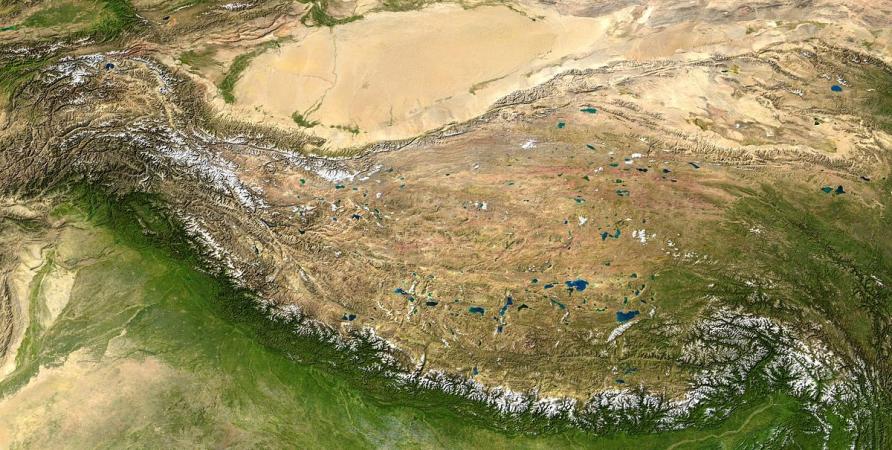
A composite satellite image of the Himalayas appearing as white chains. Picture: Wikipedia
As a consequence, declaring rivers, glaciers and other natural features legal persons typically would confer the three legal rights on these natural objects, but this cannot be assumed. When we look closely at what status the Uttarakhand High Court’s recent decisions really gives to the glaciers, lakes, meadows and other natural features, a number of questions remain.
What legal rights has the Uttarakhand High Court created for nature?
In the case of the Ganges and Yamuna rivers, the court declared that the rivers are ‘juristic/legal persons/living entities having the status of a legal person with all corresponding rights, duties and liabilities of a living person’. But in the more recent glaciers case, the court explicitly goes further, by also declaring that the ‘rights of these legal entities shall be equivalent to the rights of human beings and the injury/harm caused to these bodies shall be treated as harm/injury caused to the human beings.’
Does this mean that the Himalayan glaciers and other natural objects identified by the courts will have all the same rights as Indian citizens? This would be a significant expansion of legal rights for nature and the existing precedent surrounding the concept of legal personality.
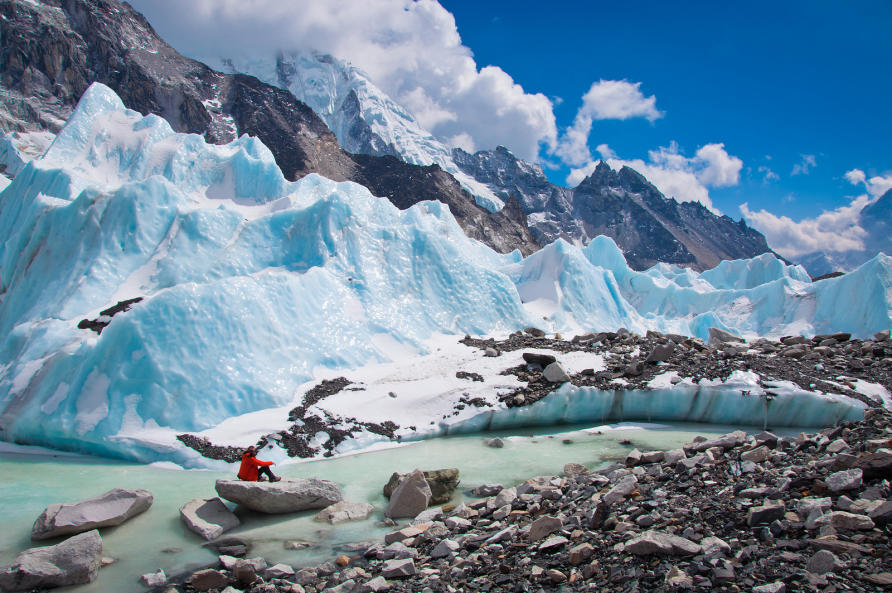
Glacier at Mount Everest base camp. Picture: Flickr/ Hendrik Terbeck
In addition, the Glaciers case also creates a very broad definition of harm and imposes a strict liability test for determining such harm:
‘Any person causing any injury and harm, intentionally or unintentionally to the Himalayas, Glaciers, rivers, streams, rivulets, lakes, air, meadows, dales, jungles and forests is liable to be proceeded against under the common law, penal laws, environmental laws and other statutory enactments governing the field.’ [sic]
Such a ruling has the capacity to create unprecedented liability for any person undertaking any activity in the state of Uttarakhand that causes harm to these natural objects. How this translates into everyday life is not yet known.
Finally, because natural objects cannot speak for themselves, the Uttarakhand High Court has treated them as minors under law. Particular government officials have been appointed to act in loco parentis (guardians) to ‘uphold the status of these bodies and also to promote their health and well-being’ throughout the entire state of Uttarakhand. But it is unclear what level of support (or independence) from government will be received by these officials as they take on their new roles, or how they will work together in the best interests of the natural objects.
What happens next?
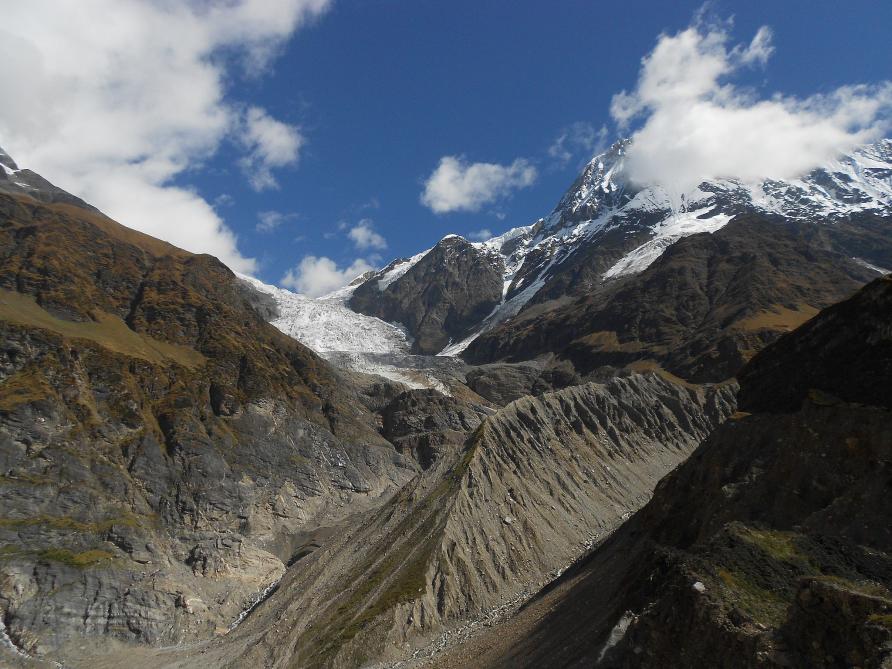
These court rulings have the capacity to significantly shift the legal landscape and broaden the basis for expanding environmental protection in India. However, there are also risks that these rulings could have unintended consequences. Beyond the legal complexities in the judgments, and immediate practical uncertainties, our research identifies three broader issues that could further affect the scope and robustness of this approach. Pindari glacier from Zero Point, Uttarakhand, India. Picture: Wikimedia
Firstly, the creation of such rights by the courts means that they are currently unsupported by broader institutional frameworks that will give the legal rights force and effect.
Secondly, the apparent transfer of responsibility for natural objects, from the hands of the parliament, to the courts, means that environmental decision-making is inherently more reactionary: the courts can only rule on a case once it comes before them.
Thirdly, if such legal rights are successfully enforced, it could result in the natural objects formally competing with humans for access to resources (such as water, air, forestry, or grazing rights in the meadows). Competition fundamentally shifts the relationship between humans and nature, and can undermine human intentions to look after the natural environment.
As India, New Zealand, Ecuador and Bolivia, take steps to grant nature legal rights as a new way to protect rivers, glaciers, and natural objects, undermining the desire to protect nature is likely to be the last thing they were expecting to do.
As climate change continues to raise the global stakes of getting this right, we need to make sure the legal tools we use to protect nature are not going to become counterproductive in the long term. Banner image: Max Pixel
In the space of a week, the world has gained three notable new legal persons: the Whanganui River in New Zealand, and the Ganga and Yamuna Rivers in India.
In New Zealand, the government passed legislation that recognised the Whanganui River catchment as a legal person. This significant legal reform emerged from the longstanding Treaty of Waitangi negotiations and is a way of formally acknowledging the special relationship local Māori have with the river.
In India, the Uttarakhand high court ruled that the Ganga and Yamuna Rivers have the same legal rights as a person, in response to the urgent need to reduce pollution in two rivers considered sacred in the Hindu religion.
What are legal rights for nature?
Legal rights are not the same as human rights, and so a “legal person” does not necessarily have to be a human being. Take corporations, for example, which are also treated in law as “legal persons”, as a way to endow companies with particular legal rights, and to treat the company as legally distinct from its managers and shareholders.
Giving nature legal rights means the law can see “nature” as a legal person, thus creating rights that can then be enforced. Legal rights focus on the idea of legal standing (often described as the ability to sue and be sued), which enables “nature” to go to court to protect its rights. Legal personhood also includes the right to enter and enforce contracts, and the ability to hold property.
There is still a big question about whether these types of legal rights are relevant or appropriate for nature at all. But what is clear from the experience of applying this concept to other non-human entities is that these legal rights don’t mean much if they can’t be enforced.
Enforcing nature’s legal rights
What does it take to enforce the legal personhood of a river or other natural entity? First, there needs to be a person appointed to act on its behalf.
Second, for a right to be enforceable, both the “guardians” and users of the resource must recognise their joint rights, duties, and responsibilities. To possess a right implies that someone else has a commensurate duty to observe this right.
Third, if a case requires adjudication by the courts, then it takes time, money, and expertise to run a successful legal case. Enforcing legal rights for nature therefore requires not only legal standing, but also adequate funding and access to legal expertise.
And finally, any actor seeking to enforce these rights will need some form of legislative independence from state and national governments, as well as sufficient real-world power to take action, particularly if such action is politically controversial.
Both New Zealand and India face considerable challenges in ensuring that the new legal rights granted to the rivers are successfully enforced. At present, New Zealand seems significantly better prepared than India to meet these challenges.
In New Zealand, the new system for managing the river will slot into existing systems of government, whereas India will need to set up completely new organisations in a matter of weeks.
Granting legal rights to New Zealand’s Whanganui River catchment (Te Awa Tupua) has taken eight years of careful negotiation. The new legislation, introduced at the national level, transfers ownership of the riverbed from the Crown to Te Awa Tupua, and assigns a guardian the responsibility of representing Te Awa Tupua’s interests.
The guardian will consist of two people: one appointed by the Whanganui Iwi (local Māori people), and the other by the New Zealand government. Substantial funds have been set aside to maintain the health of the Whanganui River, and to establish the legal framework that will be administered by the guardian, with support from independent advisory groups.
In contrast, almost overnight, the High Court in India has ruled that the Ganga and Yamuna Rivers will be treated as minors under the law, and will be represented by three people – the director general of Namami Gange project, the Uttarakhand chief secretary, and the advocate general – who will act as guardians for the river. The court has requested that within eight weeks, new boards should be established to oversee the cleaning and maintenance of the rivers. Few further details of the proposed institutional framework are available.
Big questions remain
In both cases, there are still big questions about the roles and responsibilities of the rivers’ guardians.
How will they decide which rights to enforce, and when? Who can hold them to account for those decisions and who has oversight? Even in the case of the Whanganui River, there remain biting questions about water rights and enforcement. For instance, despite (or perhaps because of) longstanding concerns about levels of water extraction by the Tongariro Power Scheme, the legislation specifically avoids creating or transferring proprietary interests in water.
Ultimately, both of these examples show that conferring legal rights to nature is just the beginning of a longer legal process, rather than the end. Although legal rights can be created overnight, it takes time and money to set up the legal and organisational frameworks that will ensure these rights are worth more than the paper they’re printed on.
Since the Millennium Drought of 2000-2010 (and particularly the devastatingly dry period of 2007-2010), Australians have significantly improved the efficiency of our water resource management. Much of the interest focused on reforms to rural water use, including the development of highly effective water markets in the Murray-Darling Basin.
But Australia learnt some really important lessons about urban water management too. In particular, in Melbourne, where I live, there was a real success story in achieving behavioural change to reduce water demand during the drought.
The 'Target 155' campaign urged all Melbournians to cut their personal water use to 155 litres per person per day, and this was a significant contributor to Melbourne's ability to survive the 2007-2010 drought without major cuts to industry and employment. Whilst increased water availability over the past five years has caused water use to drift upwards again (to over 166 litres per person per day), this is still considered low for urban use in a developed country. As the Target 155 is brought out again this summer, it's helpful to review just how powerful it was the first time around.
This article in the New York Times shows how important the behavioural change campaign was, and that one of the elements of success was working with the people of Melbourne, rather than imposing this limit on them.
The article is a really interesting read, and shows the crucial importance of tackling water demand rather than automatically (and only) reaching for supply augmentations (although Melbourne did both, by building the desalination plant as well as working to cut water demand).
Australia's water markets continue to be recognised as world leaders in supporting rapid, flexible, enforceable and cheap transfers of water rights, especially in the southern connected Murray-Darling Basin.
Everyone loves a good water market story, and one of the enduring tropes in the narratives of water markets is the 'evil' of big business speculators buying up water rights that might otherwise have been available to farmers. So when editors at The Conversation reached out to me to comment on this issue, it seemed like a good time to dig into the facts.
And the facts are, although there are still real threats to water markets as a tool for effective, efficient and equitable regulation of Australia's water resources, speculation by investors is (so far) not one of them.
Investors and speculators aren't disrupting the water markets
These markets are also huge – the estimated total value of water entitlements in the Murray-Darling Basin (MDB) was over $A11.5 billion in 2015-16. The sheer size of the markets has led investors to join the fray.
But there is now rising concern about investors in water markets. Will speculation drive up water prices, pricing out farmers? Do investment firms take water away from irrigators, or the environment? Is speculation impacting water resource management in the MDB?
The data shows these fears to be overblown. Investors make up only a tiny proportion of the water market and there are far greater concerns for those reliant on it – the climate, efficiency drives and political uncertainty among them. In fact, speculators may even be beneficial as they add flexibility to the market.
How water is traded in Australia
Water markets offer farmers the flexibility to manage risk by transferring water to its highest value or most profitable use. They also allow water to move to other socially-valued uses such as environmental watering. This is best exemplified during a drought, when farmers with perennial crops (e.g. trees or vines) can buy water rights from farmers with annual crops (e.g. cotton or rice), who decide not to produce. Water markets have saved many farmers and their crops during previous droughts.
Water resource management in the MDB is an example of the “cap and trade” system. The cap is a limit on how much water can be allocated for consumption. Under this system, water is “owned” either as shares or entitlements (a permanent right to receive ongoing water allocations). Available water is allocated against those shares/entitlements each year (e.g. during a drought farmers may receive 40% of their entitlement).
Both shares and entitlements can be owned by, or transferred to, other water users. This includes investors and “the environment”, under the guise of an organisation like the Commonwealth Environmental Water Holder. The decision by any owner to use or trade water will depend on the price of water, which varies among different parts of the catchment, and across years.
Functional water markets depend on four fundamentals – well-defined water rights, many buyers and sellers, easy transfer between different users/uses and locations, and reliable and adequate information. All four are present to varying degrees in the southern-connected MDB water markets as a result of a combination of historical factors and ongoing government investment.
What water speculation ‘looks like’
Speculation in any market takes two main forms – short-term arbitrage (simultaneous buying and selling where there is a price difference between different markets or exchanges) or long-term investing in water entitlements and then selling or leasing annual water allocations to users. Therefore, speculation, especially the long-term kind, can lead to “hoarding” of water by non-users (those without farm land), which could distort supply for farmers and increase prices.
But if we look at the changes to available water over the last decade there is little evidence that speculation is impacting the water market. The vast majority of water rights are still held by farmers. At most, Victorian estimates put speculation activity at around 5% of water market activity, which is not a significant proportion and unlikely to distort trade. Speculators also remain a very small proportion of total water holdings without land. Most water rights not attached to land are still owned by farmers.
In fact, water entitlement prices are mainly driven by periods of low/high supply climate events, as shown in the chart below. The millenium drought saw prices rise dramatically from 2006/07 until 2009/10 when the drought broke. Increases from 2013/14 correspond again to low supply, which in recent months has been reversed.
Goulburn Murray Irrigation District trade prices 1993-2016 (source: author provided).
Some may argue that water purchased from willing sellers through buybacks for environmental use has increased prices, but again this is unlikely. This argument is based on the idea that reallocating water to the environment has removed huge volumes from trade. But it ignores the fact that Commonwealth purchased entitlements are only around 13% of the total entitlement volume in the southern connected MDB and far, far less in the northern part of the Basin.
The concerns are unwarranted
According to the data, speculation is neither affecting water prices, nor driving significant changes in the way water is used. In fact, given the broader trends of water use in the MDB towards high value, perennial crops, as well as government incentives encouraging farmers to transform toward such systems, increasing the volume of water held by speculators could be beneficial.
By definition, speculators aren’t making use of their water entitlements. This water is effectively “uncommitted” to existing crops, which means during a drought the allocations can be sold to perennial farmers, enabling them to keep their crops alive.
All water users have a vested interest in maintaining the functionality of Australia’s water markets. But fear of water speculators is a red herring, and any negative impacts of speculators on the water markets are likely to be dwarfed by that of government intervention, efficiency incentives and ongoingpoliticaluncertainty.