My PhD has been passed, and I am now officially Dr O'Donnell!
The full thesis is available for download, and the short version is:
In 2010, the Victorian government created the Victorian Environmental Water Holder (VEWH) to be ‘the single voice’ for environmental water rights in Victoria. The VEWH is one of many ‘environmental water managers’ (EWMs) operating around the world. EWMs use a variety of legal forms to establish legal personhood to participate in water markets to acquire and manage water for the aquatic environment. The creation and operation of EWMs raises the question: what happens when the environment is constructed in law as a legal person? I use the example of the EWMs in Australia and the USA to develop a new conceptual framework to understand how the environment is constructed in law, and how the multiple constructions can interact in unintended ways. In particular, I find that there is an apparent paradox in the creation and operation of the EWMs: they are a regulatory tool intended to increase the legibility of the environment to law, and increase the rights and powers of the environment in law, but in doing so, they reframe the environment as a mere participant in a market, which can weaken the cultural narratives that support environmental protection.
The even shorter version: be careful what you wish for. Granting legal personality to the environment is a powerful legal tool, but it fundamentally reshapes the relationship between humanity and nature. Whilst giving nature the power to stick up for itself, and to fight back against pollution and degradation, can be important and useful, it can also leave people feeling that now they don't have to look after the environment. Even worse, because the environment is now a competitor for access to resources, people start to wonder whether they have recourse against the environment when things go wrong.
One of the most common responses to my articles documenting the legal rights for rivers that have emerged in 2017 has been: great, so can we sue the river when it floods our land?
In fact, one of the reasons that the State Government of Uttarakhand appealed the High Court ruling that granted legal rights to the Ganges and Yamuna Rivers in India is that they were concerned that they, as guardians for the river, would be held liable for the actions of the river. They were worried that people would sue them when the rivers flood in future.
Legal rights for nature advocates have long thought that placing nature on a level footing with people in the eyes of the law would transform our understanding of nature, changing it from a resource to be exploited, into a partner and equal. Turns out, this may have been a bit optimistic.
But all is not lost. I think the solution to this challenge is to keep talking about why environmental protection matters, and why it matters to all of us. We don't have to let legal rights undermine our willingness to protect nature, but as environmental advocates, or policy-makers, or new organisations who speak for the environment, we do need to actively keep building trust and support throughout the community.
Legal rights for rivers seems to be an idea whose time has come.
This week, Deep Green Resistance filed suit on behalf of the Colorado River, to establish it as a legal person with the ability to sue in court to protect its own interests.
In July, the Siletz River Ecosystem in Oregon, USA, also filed an action to prevent the aerial spraying of pesticides within the river catchment.
Both cases are arguing that granting legal standing to the river will enable it to protect its interests holistically, and proactively. In Colorado, the law suit is an action against the state of Colorado for violating the river's "right to exist, flourish, regenerate, be restored, and naturally evolve".
In Oregon, the lawsuit stems from a local ordinance, which gives the right for local ecosystems and communities to be free from aerially sprayed pesticides.This ordinance means that the river in this case is one of the defendants, as the plaintiffs attempt to assert their right to apply pesticides. The court documents state that the right to be "free from toxic tresspass" is "essential for nature - the physical world including human beings - to survive and thrive".
So far, US courts have been consistently unwilling to embrace legal rights for nature. However, in 2017, there is an emerging transnational jurisprudence supporting the creation of legal rights for rivers, as evidenced by legislation in New Zealand and the Constitutional Court ruling in Colombia (which specifically referenced the New Zealand examples). In India, the ruling of the High Court which granted legal personality to the Ganges and Yamuna Rivers has been stayed by the Supreme Court, pending the outcome of an appeal.
At the recent 20th International Riversymposium in Brisbane, Australia, a plenary session was devoted to the discussion of legal rights for rivers, with speakers from the Whanganui River in New Zealand, and Western Australia, where the concept is being developed by the Madjulla people for the Mardoowarra River.
In 2017, we have seen four rivers around the world receive the status of legal persons.
In March, the New Zealand government passed legislation that declared the Whanganui River to be a legal person, as part of settling a long-running dispute under the Treaty of Waitangi.
Also in March, the Ganges and Yamuna Rivers in India were given the status of legal persons. The High Court of Uttarakhand (an Indian state) declared that these rivers were to be considered as 'minors' and appointed several key people in the state government to act as guardians.
Then, in May, the Constitutional Court in Colombia ruled that the Rio Atrato also had legal rights of its own, as part of recognising a suite of biocultural rights of the local and indigenous communities who live on and near the river.
After seeing very little in the way of movement in this space since 2010, it is extraordinary and exciting to see these ground-breaking legal decisions creating legal rights for rivers.
But will these new rights help to protect the rivers?
And how does giving legal rights to nature re-shape our own relationship to nature?
My research points to a fundamental shift that happens when nature has legal rights of its own: we start to expect nature to look after itself, and correspondingly, we begin to be less willing to take action to protect it.
This means that these innovative legal experiments in the expansion of legal rights for nature can come with real costs, and using legal rights in this way is unlikely to be a panacea for environmental protection.
It is now time to invest in research and analysis that considers not if nature should have rights, but how those rights can be created and enforced so that environmental outcomes are actually improved.
This week, I have recorded a podcast through the University of Melbourne program Up Close, with Julia Talbot-Jones from ANU, to explore these emerging issues, and start to understand exactly what happens when you create legal rights for nature.
Himalayan glaciers, rivers, streams, lakes, air, meadows and forests now have the same legal rights as people after the Uttarakhand High Court in India granted these natural treasures this new status as a way to protect them from pollution and environmental destruction.
The ruling, made on 30 March 2017, aims to ‘preserve and conserve’ the ‘Glaciers including Gangotri and Yamunotri, rivers, streams, rivulets, lakes, air, meadows, dales, jungles, forests wetlands, grasslands, springs and waterfalls’ of the Himalayas.
View from Kalindi Peak of Himalayas located at Uttarkashi district of Uttarakhand, India. Picture: Wikimedia
This ground-breaking ruling came ten days after the same court ruled India’s sacred Ganges and Yamuna rivers were also legal persons. At the same time, the New Zealand Government passed legislation recognising Whanganui River as a legal person. Collectively, the establishment of these new legal persons represents the most significant creation of new legal rights for nature since 2010, when Bolivia passed the Law of Mother Earth.
A duty to protect the sacred and ecological values
The Yumanotri and Gangotri glaciers feed the Yumana and Ganges rivers, both of which the court considered to be ‘sacred and revered… central to the existence of half the Indian population’. The court argued that both the Yumanotri and Gangotri glaciers are receding quickly and there is a ‘moral duty to protect the environment and ecology’ from the severe risks of climate change and pollution.
Both statements significantly broaden the basis on which the court can act to protect the environment. But in granting these rights, what legal powers has the Uttarakhand High Court bestowed on the Himalayan environment? And will these rights really help to protect them?
What are legal rights?
To be a legal person, one does not have to be human. Legal persons are entities, which the law regards as capable of bearing rights and duties. For example, corporations have long been granted legal personality. Legal personality typically confers three primary rights: the right to sue and be sued (legal standing), the right to enter contracts, and the right to hold property. When applied to nature, theoretically a natural object can protect its rights by taking legal action to address claims of injury and seek relief from the courts.
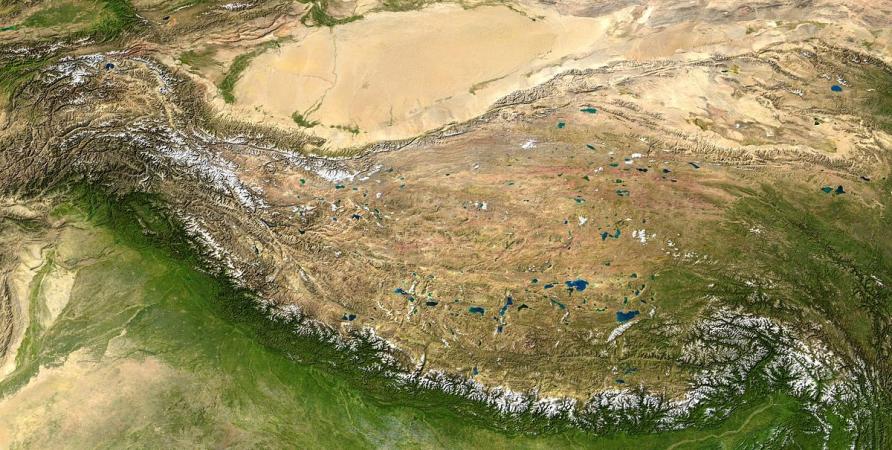
A composite satellite image of the Himalayas appearing as white chains. Picture: Wikipedia
As a consequence, declaring rivers, glaciers and other natural features legal persons typically would confer the three legal rights on these natural objects, but this cannot be assumed. When we look closely at what status the Uttarakhand High Court’s recent decisions really gives to the glaciers, lakes, meadows and other natural features, a number of questions remain.
What legal rights has the Uttarakhand High Court created for nature?
In the case of the Ganges and Yamuna rivers, the court declared that the rivers are ‘juristic/legal persons/living entities having the status of a legal person with all corresponding rights, duties and liabilities of a living person’. But in the more recent glaciers case, the court explicitly goes further, by also declaring that the ‘rights of these legal entities shall be equivalent to the rights of human beings and the injury/harm caused to these bodies shall be treated as harm/injury caused to the human beings.’
Does this mean that the Himalayan glaciers and other natural objects identified by the courts will have all the same rights as Indian citizens? This would be a significant expansion of legal rights for nature and the existing precedent surrounding the concept of legal personality.
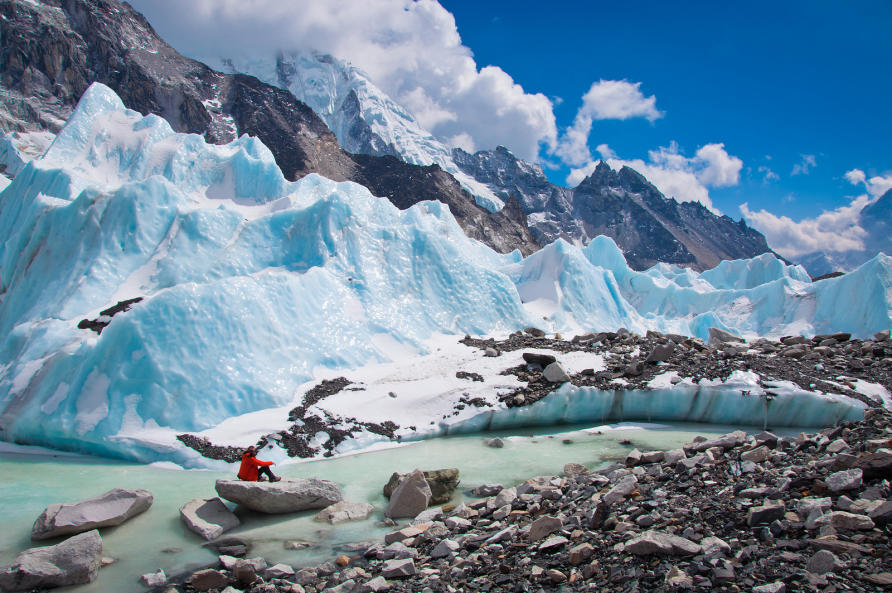
Glacier at Mount Everest base camp. Picture: Flickr/ Hendrik Terbeck
In addition, the Glaciers case also creates a very broad definition of harm and imposes a strict liability test for determining such harm:
‘Any person causing any injury and harm, intentionally or unintentionally to the Himalayas, Glaciers, rivers, streams, rivulets, lakes, air, meadows, dales, jungles and forests is liable to be proceeded against under the common law, penal laws, environmental laws and other statutory enactments governing the field.’ [sic]
Such a ruling has the capacity to create unprecedented liability for any person undertaking any activity in the state of Uttarakhand that causes harm to these natural objects. How this translates into everyday life is not yet known.
Finally, because natural objects cannot speak for themselves, the Uttarakhand High Court has treated them as minors under law. Particular government officials have been appointed to act in loco parentis (guardians) to ‘uphold the status of these bodies and also to promote their health and well-being’ throughout the entire state of Uttarakhand. But it is unclear what level of support (or independence) from government will be received by these officials as they take on their new roles, or how they will work together in the best interests of the natural objects.
What happens next?
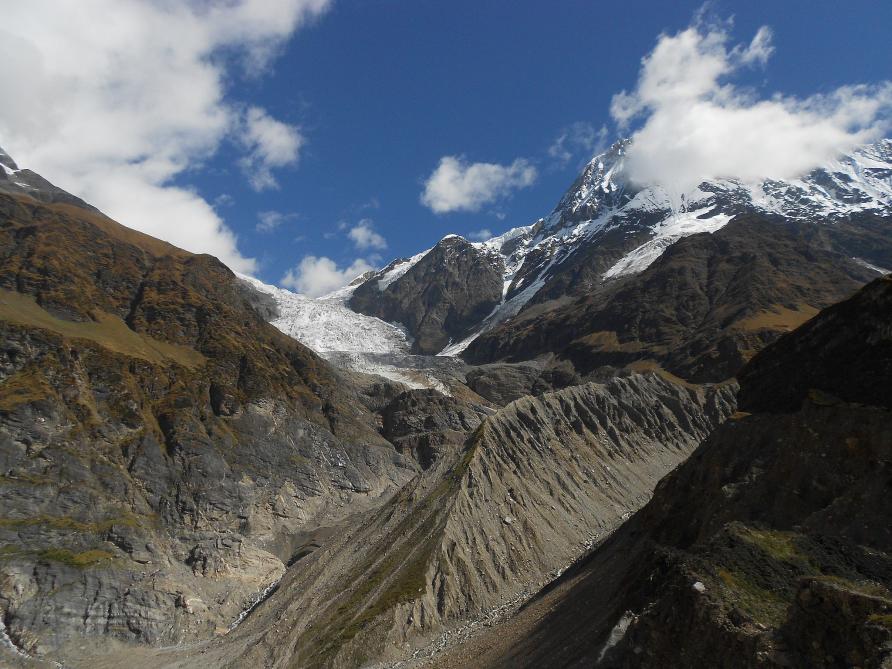
These court rulings have the capacity to significantly shift the legal landscape and broaden the basis for expanding environmental protection in India. However, there are also risks that these rulings could have unintended consequences. Beyond the legal complexities in the judgments, and immediate practical uncertainties, our research identifies three broader issues that could further affect the scope and robustness of this approach. Pindari glacier from Zero Point, Uttarakhand, India. Picture: Wikimedia
Firstly, the creation of such rights by the courts means that they are currently unsupported by broader institutional frameworks that will give the legal rights force and effect.
Secondly, the apparent transfer of responsibility for natural objects, from the hands of the parliament, to the courts, means that environmental decision-making is inherently more reactionary: the courts can only rule on a case once it comes before them.
Thirdly, if such legal rights are successfully enforced, it could result in the natural objects formally competing with humans for access to resources (such as water, air, forestry, or grazing rights in the meadows). Competition fundamentally shifts the relationship between humans and nature, and can undermine human intentions to look after the natural environment.
As India, New Zealand, Ecuador and Bolivia, take steps to grant nature legal rights as a new way to protect rivers, glaciers, and natural objects, undermining the desire to protect nature is likely to be the last thing they were expecting to do.
As climate change continues to raise the global stakes of getting this right, we need to make sure the legal tools we use to protect nature are not going to become counterproductive in the long term. Banner image: Max Pixel
In the space of a week, the world has gained three notable new legal persons: the Whanganui River in New Zealand, and the Ganga and Yamuna Rivers in India.
In New Zealand, the government passed legislation that recognised the Whanganui River catchment as a legal person. This significant legal reform emerged from the longstanding Treaty of Waitangi negotiations and is a way of formally acknowledging the special relationship local Māori have with the river.
In India, the Uttarakhand high court ruled that the Ganga and Yamuna Rivers have the same legal rights as a person, in response to the urgent need to reduce pollution in two rivers considered sacred in the Hindu religion.
What are legal rights for nature?
Legal rights are not the same as human rights, and so a “legal person” does not necessarily have to be a human being. Take corporations, for example, which are also treated in law as “legal persons”, as a way to endow companies with particular legal rights, and to treat the company as legally distinct from its managers and shareholders.
Giving nature legal rights means the law can see “nature” as a legal person, thus creating rights that can then be enforced. Legal rights focus on the idea of legal standing (often described as the ability to sue and be sued), which enables “nature” to go to court to protect its rights. Legal personhood also includes the right to enter and enforce contracts, and the ability to hold property.
There is still a big question about whether these types of legal rights are relevant or appropriate for nature at all. But what is clear from the experience of applying this concept to other non-human entities is that these legal rights don’t mean much if they can’t be enforced.
Enforcing nature’s legal rights
What does it take to enforce the legal personhood of a river or other natural entity? First, there needs to be a person appointed to act on its behalf.
Second, for a right to be enforceable, both the “guardians” and users of the resource must recognise their joint rights, duties, and responsibilities. To possess a right implies that someone else has a commensurate duty to observe this right.
Third, if a case requires adjudication by the courts, then it takes time, money, and expertise to run a successful legal case. Enforcing legal rights for nature therefore requires not only legal standing, but also adequate funding and access to legal expertise.
And finally, any actor seeking to enforce these rights will need some form of legislative independence from state and national governments, as well as sufficient real-world power to take action, particularly if such action is politically controversial.
Both New Zealand and India face considerable challenges in ensuring that the new legal rights granted to the rivers are successfully enforced. At present, New Zealand seems significantly better prepared than India to meet these challenges.
In New Zealand, the new system for managing the river will slot into existing systems of government, whereas India will need to set up completely new organisations in a matter of weeks.
Granting legal rights to New Zealand’s Whanganui River catchment (Te Awa Tupua) has taken eight years of careful negotiation. The new legislation, introduced at the national level, transfers ownership of the riverbed from the Crown to Te Awa Tupua, and assigns a guardian the responsibility of representing Te Awa Tupua’s interests.
The guardian will consist of two people: one appointed by the Whanganui Iwi (local Māori people), and the other by the New Zealand government. Substantial funds have been set aside to maintain the health of the Whanganui River, and to establish the legal framework that will be administered by the guardian, with support from independent advisory groups.
In contrast, almost overnight, the High Court in India has ruled that the Ganga and Yamuna Rivers will be treated as minors under the law, and will be represented by three people – the director general of Namami Gange project, the Uttarakhand chief secretary, and the advocate general – who will act as guardians for the river. The court has requested that within eight weeks, new boards should be established to oversee the cleaning and maintenance of the rivers. Few further details of the proposed institutional framework are available.
Big questions remain
In both cases, there are still big questions about the roles and responsibilities of the rivers’ guardians.
How will they decide which rights to enforce, and when? Who can hold them to account for those decisions and who has oversight? Even in the case of the Whanganui River, there remain biting questions about water rights and enforcement. For instance, despite (or perhaps because of) longstanding concerns about levels of water extraction by the Tongariro Power Scheme, the legislation specifically avoids creating or transferring proprietary interests in water.
Ultimately, both of these examples show that conferring legal rights to nature is just the beginning of a longer legal process, rather than the end. Although legal rights can be created overnight, it takes time and money to set up the legal and organisational frameworks that will ensure these rights are worth more than the paper they’re printed on.
Since the Millennium Drought of 2000-2010 (and particularly the devastatingly dry period of 2007-2010), Australians have significantly improved the efficiency of our water resource management. Much of the interest focused on reforms to rural water use, including the development of highly effective water markets in the Murray-Darling Basin.
But Australia learnt some really important lessons about urban water management too. In particular, in Melbourne, where I live, there was a real success story in achieving behavioural change to reduce water demand during the drought.
The 'Target 155' campaign urged all Melbournians to cut their personal water use to 155 litres per person per day, and this was a significant contributor to Melbourne's ability to survive the 2007-2010 drought without major cuts to industry and employment. Whilst increased water availability over the past five years has caused water use to drift upwards again (to over 166 litres per person per day), this is still considered low for urban use in a developed country. As the Target 155 is brought out again this summer, it's helpful to review just how powerful it was the first time around.
This article in the New York Times shows how important the behavioural change campaign was, and that one of the elements of success was working with the people of Melbourne, rather than imposing this limit on them.
The article is a really interesting read, and shows the crucial importance of tackling water demand rather than automatically (and only) reaching for supply augmentations (although Melbourne did both, by building the desalination plant as well as working to cut water demand).
Australia's water markets continue to be recognised as world leaders in supporting rapid, flexible, enforceable and cheap transfers of water rights, especially in the southern connected Murray-Darling Basin.
Everyone loves a good water market story, and one of the enduring tropes in the narratives of water markets is the 'evil' of big business speculators buying up water rights that might otherwise have been available to farmers. So when editors at The Conversation reached out to me to comment on this issue, it seemed like a good time to dig into the facts.
And the facts are, although there are still real threats to water markets as a tool for effective, efficient and equitable regulation of Australia's water resources, speculation by investors is (so far) not one of them.
Investors and speculators aren't disrupting the water markets
These markets are also huge – the estimated total value of water entitlements in the Murray-Darling Basin (MDB) was over $A11.5 billion in 2015-16. The sheer size of the markets has led investors to join the fray.
But there is now rising concern about investors in water markets. Will speculation drive up water prices, pricing out farmers? Do investment firms take water away from irrigators, or the environment? Is speculation impacting water resource management in the MDB?
The data shows these fears to be overblown. Investors make up only a tiny proportion of the water market and there are far greater concerns for those reliant on it – the climate, efficiency drives and political uncertainty among them. In fact, speculators may even be beneficial as they add flexibility to the market.
How water is traded in Australia
Water markets offer farmers the flexibility to manage risk by transferring water to its highest value or most profitable use. They also allow water to move to other socially-valued uses such as environmental watering. This is best exemplified during a drought, when farmers with perennial crops (e.g. trees or vines) can buy water rights from farmers with annual crops (e.g. cotton or rice), who decide not to produce. Water markets have saved many farmers and their crops during previous droughts.
Water resource management in the MDB is an example of the “cap and trade” system. The cap is a limit on how much water can be allocated for consumption. Under this system, water is “owned” either as shares or entitlements (a permanent right to receive ongoing water allocations). Available water is allocated against those shares/entitlements each year (e.g. during a drought farmers may receive 40% of their entitlement).
Both shares and entitlements can be owned by, or transferred to, other water users. This includes investors and “the environment”, under the guise of an organisation like the Commonwealth Environmental Water Holder. The decision by any owner to use or trade water will depend on the price of water, which varies among different parts of the catchment, and across years.
Functional water markets depend on four fundamentals – well-defined water rights, many buyers and sellers, easy transfer between different users/uses and locations, and reliable and adequate information. All four are present to varying degrees in the southern-connected MDB water markets as a result of a combination of historical factors and ongoing government investment.
What water speculation ‘looks like’
Speculation in any market takes two main forms – short-term arbitrage (simultaneous buying and selling where there is a price difference between different markets or exchanges) or long-term investing in water entitlements and then selling or leasing annual water allocations to users. Therefore, speculation, especially the long-term kind, can lead to “hoarding” of water by non-users (those without farm land), which could distort supply for farmers and increase prices.
But if we look at the changes to available water over the last decade there is little evidence that speculation is impacting the water market. The vast majority of water rights are still held by farmers. At most, Victorian estimates put speculation activity at around 5% of water market activity, which is not a significant proportion and unlikely to distort trade. Speculators also remain a very small proportion of total water holdings without land. Most water rights not attached to land are still owned by farmers.
In fact, water entitlement prices are mainly driven by periods of low/high supply climate events, as shown in the chart below. The millenium drought saw prices rise dramatically from 2006/07 until 2009/10 when the drought broke. Increases from 2013/14 correspond again to low supply, which in recent months has been reversed.
Goulburn Murray Irrigation District trade prices 1993-2016 (source: author provided).
Some may argue that water purchased from willing sellers through buybacks for environmental use has increased prices, but again this is unlikely. This argument is based on the idea that reallocating water to the environment has removed huge volumes from trade. But it ignores the fact that Commonwealth purchased entitlements are only around 13% of the total entitlement volume in the southern connected MDB and far, far less in the northern part of the Basin.
The concerns are unwarranted
According to the data, speculation is neither affecting water prices, nor driving significant changes in the way water is used. In fact, given the broader trends of water use in the MDB towards high value, perennial crops, as well as government incentives encouraging farmers to transform toward such systems, increasing the volume of water held by speculators could be beneficial.
By definition, speculators aren’t making use of their water entitlements. This water is effectively “uncommitted” to existing crops, which means during a drought the allocations can be sold to perennial farmers, enabling them to keep their crops alive.
All water users have a vested interest in maintaining the functionality of Australia’s water markets. But fear of water speculators is a red herring, and any negative impacts of speculators on the water markets are likely to be dwarfed by that of government intervention, efficiency incentives and ongoingpoliticaluncertainty.